

How to Plan a Granny Square Blanket
Before making a basket of squares, make one representative square and decide how the pieces will join. That gives you a real basis for the layout, dimensions and yarn estimate. This is a planning guide, not a complete blanket pattern.

Use a checked square pattern and its stated corner, side-space and joining instructions.
Finish a sample square first
The classic granny square lesson explains one construction in US crochet terms.
Use the yarn, hook and number of rounds you intend to repeat. Secure the ends and finish the square according to the yarn's care directions and the pattern's instructions.
Lay it flat without forcing it into a larger size. Measure its width and height, and check the stitch and space counts on each side. A square with an extra group can look close enough until you try to join it to the others.
The blocking and care lesson explains why the finishing method needs to suit the actual yarn. Measure after the finishing process you plan to use on the blanket, rather than comparing a washed sample with an unwashed one.
Keep the sample with its label and a note of the hook size. If you later change hooks, recheck the dimensions before assuming the new squares will match.
Choose the join before fixing the layout
A sewn join, crocheted seam and join-as-you-go method do not necessarily produce the same finished width, ridge or flexibility. Try the chosen join between two squares before you settle the total dimensions.
The joining-squares guide compares sewn, crocheted and join-as-you-go approaches.
Check which loops or spaces it uses and whether the squares need the same edge count. A seam that pulls one side shorter is not solved by adding more squares to the layout.
For a joined sample pair, measure the full width across both squares. Compare that with twice the width of one square. The difference tells you more about that particular join than a generic promise that a seam adds no width.
Turn dimensions into a useful layout
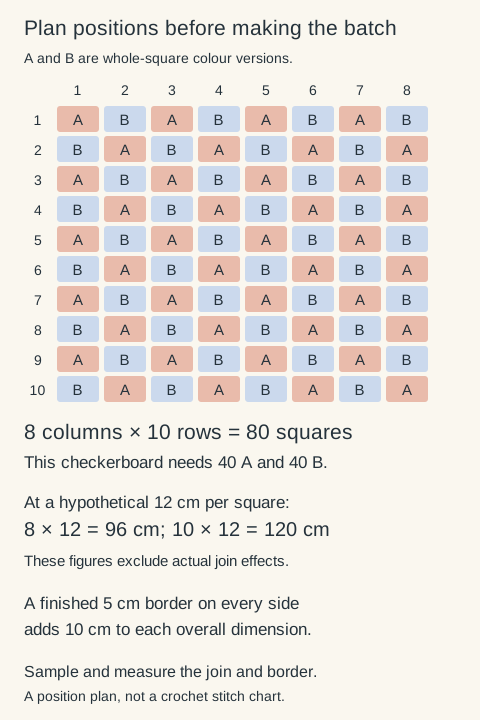
Suppose your finished square measures 12 cm by 12 cm. An arrangement of eight columns and ten rows contains 80 squares. Before accounting for join effects, the square measurements alone suggest:
8 × 12 = 96 cm wide, and 10 × 12 = 120 cm long.
Those are planning dimensions, not guaranteed finished measurements. Use the joined sample to refine them.
If a border eventually adds a finished 5 cm on every side, it adds 10 cm to the overall width and 10 cm to the overall length. Ignoring join effects for this arithmetic example, that would suggest 106 cm by 130 cm. The border's actual stitch count, corners and final width still need to be established.
Draw the grid and label columns across the top and rows down the side. Numbering the positions makes it easier to discuss a colour change or replace a square later.
Plan the granny square blanket layout by colour
Choose whether every square follows the same colour order, alternates between a few versions or changes across the whole grid. Count how many squares each version needs.
For example, alternating two square versions across an eight-by-ten checkerboard uses forty of each. A layout with an odd number of positions may not split evenly, so count from the drawn grid rather than assuming half.
If each square itself has several colours, record those requirements within each version. Forty squares of a colour arrangement does not mean forty balls of its main yarn.
Photograph your own layout before lifting the pieces, or label the squares by grid position. Keep the orientation of any directional motif or textured face consistent with the joining instructions.
Estimate the yarn in separate parts
Measure the yarn used by a representative finished square, ideally recording each colour. Multiply by the number of that version in your layout, then add separate estimates for the join and border.
As a hypothetical whole-square example, 17 metres per square × 80 squares = 1,360 metres in the squares alone. That figure does not tell you how much of each colour to buy, nor does it include joining yarn or the border.
If your measured sample will become one of the eighty squares, its yarn is already part of that total. Extra test squares that will not go into the blanket need a separate allowance. Keep that distinction in your notes so the same sample is not accidentally counted twice.
The gauge guide helps with consistent measuring. The yarn calculator estimates rectangular fabric from a sample; it does not automatically include every square's tails, motif joins and decorative border.
Check the batch as you go
Compare new squares with the finished sample at intervals. Count the groups and spaces before fastening off, and check dimensions after the same finishing treatment. Do not stretch an incorrectly counted square until it appears to match.
When several sizes have already appeared, separate count differences from tension or finishing differences before joining. A joined blanket is harder to correct than a small stack of individual squares.
Keep the layout, colour counts, sample measurements and joining method together. The beginner learning guide connects the underlying lessons; your chosen pattern supplies the exact blanket instructions.
A tape measure and a clear ruler
Use a flexible tape for body measurements and a ruler or gauge tool to count stitches across a flat sample. Check centimetre and inch markings. Measure without stretching the fabric and follow the pattern’s gauge instructions.
Dritz 60-inch Tape Measure, Inches and CentimetresView on Amazon Westcott 10561 Clear Acrylic Ruler, 6 InchesView on AmazonNeedle, scissors and finishing supplies
A blunt yarn needle and small scissors are useful for weaving ends and assembly. Choose the needle eye for your yarn and use scissors suited to cutting yarn. Store sharp tools safely.
Susan Bates 70773 Blunt Steel Yarn Needles, Size 16, Five-PackView on Amazon Jaasuee J5064 Embroidery Scissors with Protective Sheath, 3.62 InchesView on AmazonYour next step
Keep making. Keep learning.
Compare the actual edge counts, seam construction and finished pair before fixing the blanket dimensions.
Choose and sample the join