UK vs US Crochet Terms: How to Tell the Difference
You can follow a crochet pattern carefully and still make the wrong stitch if you start with the wrong terminology. The letters dc are the usual troublemaker.

They mean double crochet in both systems, but those two double crochet stitches are different heights. The Slow Stitch uses US terms. If your pattern uses UK terms, translate the stitch name before following one of our stitch lessons. Keep the pattern's stitch counts, placements and shaping instructions as written.
Start with the pattern's own note
Look near the materials, abbreviations or opening instructions for a statement such as “US crochet terminology” or “UK terms used throughout.” That statement is more useful than the designer's address or the shop where you bought the pattern. Designers can write in either system regardless of where they live.
If a pattern includes a stitch definition, read the actual movements too. The same abbreviation may be used for a special stitch defined only for that project. When the terminology is not stated and the instructions remain ambiguous, ask the designer rather than guessing from the finished photograph.
The everyday stitches with different names
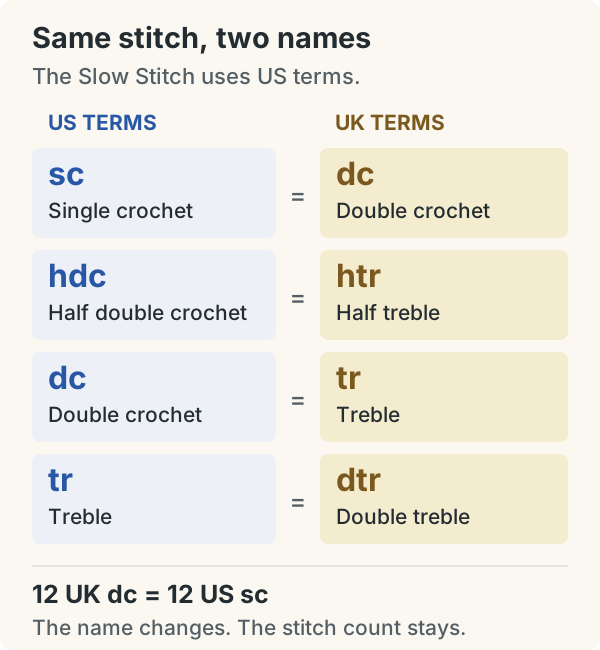
For the common stitches taught on this site, the usual equivalents are:
- US single crochet (sc): UK double crochet (dc). No yarn-over before inserting the hook; finish by pulling through both loops.
- US half double crochet (hdc): UK half treble (htr). Yarn over before insertion; the usual finish draws through all three loops.
- US double crochet (dc): UK treble (tr). Yarn over before insertion, then complete the stitch in two pull-through stages.
- US treble crochet (tr): UK double treble (dtr). Begin with two yarn-overs and complete three pull-through stages.
Chain and slip stitch are commonly called the same thing in both systems. Taller or unusual stitches still need checking against the pattern's abbreviation list. The crochet glossary is a useful reference while you read.
These are name equivalents, not instructions to change how many stitches you make. A row containing twelve UK double crochets becomes a row containing twelve US single crochets when translated.
Translate a short instruction, not just one abbreviation
Suppose a UK pattern says: “Dc in each of the next 8 sts.”
In US terminology, that means: “Sc in each of the next 8 sts.” You still work once into each of eight existing stitches. The location and count stay the same.
Now consider “2 dc in the next st” in a UK pattern. This becomes “2 sc in the next st” in US terms. Both new stitches go into the same existing stitch. Translating the name does not turn an increase into two ordinary stitches in separate places.
Our single crochet lesson demonstrates the US stitch used in these examples. Read the pattern's notes about chains, joins and repeats separately; those details cannot be inferred from the stitch name alone.
What does not change when you translate terms?
The physical size of a 4 mm hook remains 4 mm. The size in millimetres is a measurement, not a US or UK stitch term. Letter and number hook labels are a separate naming issue, which the hook size converter can help with.
The yarn quantity and finished measurements also remain whatever the pattern specifies. Translating UK treble into US double crochet does not make a larger version of the project. It is a different name for the intended stitch.
Be careful with the word “tension.” It can describe how firmly someone handles yarn, but a pattern's tension measurement usually means the gauge you are expected to match. Compare the stated stitches and rows over the stated area. Do not simply pull the yarn tighter because the terminology is unfamiliar.
Do the chart symbols tell you which system it is?
A stitch chart may make the intended stitch easier to recognise, especially when a legend names or demonstrates it. Read that legend rather than assuming every chart uses identical conventions.
A colour grid is a different kind of chart. One coloured square may represent a stitch, a block or another unit defined by the instructions. The colour alone does not identify the stitch or terminology. Our chart-reading lesson explains the distinction between stitch symbols and the directions that accompany them.
Keep a translation note where you can see it
Write a small key at the top of your working copy: “This pattern uses UK terms; UK dc = US sc.” Add only the stitches the project actually uses. That is easier to consult than translating a long list of irrelevant abbreviations every time you begin a row.
If you keep switching between a UK pattern and US tutorials, check the key before each new stitch or shaping section. A consistent wrong translation can produce an even-looking piece that is still the wrong size and texture.
If your fabric seems unexpectedly tall, open or heavy, stop and compare the stitch movements with the definition before changing hooks or yarn. A smaller hook cannot reliably correct a different stitch.
Your next step
Keep making. Keep learning.
Look up the abbreviations your pattern uses and compare its US and UK stitch names.
Keep the stitch key nearby