
Does the Turning Chain Count as a Crochet Stitch?
A turning chain brings the yarn up to the height needed for a new row. Sometimes it also takes the place of the first stitch.

Sometimes it does not. That distinction decides where your hook goes next and what you count at the end. If the edges keep stepping outward or inward, check the turning-chain rule before blaming your tension. The explanations here use US crochet terminology. Follow your pattern's stated rule even if a different project used another convention.
Find the rule before making the chain
Look for notes such as “ch 1 does not count as a stitch” or “beginning ch 3 counts as first dc.” A pattern may put the turning chain at the end of the previous row or at the beginning of the next one. Read the whole transition so you do not add it twice.
Single crochet is often worked with an uncounted chain 1, while double crochet patterns may use a counted beginning chain. These are common arrangements, not a universal law. Some patterns use fewer chains, a standing stitch or another beginning method.
The chain height and the question of whether it counts are related instructions, but they are not the same instruction. Do not decide that a chain must count merely because it looks tall.
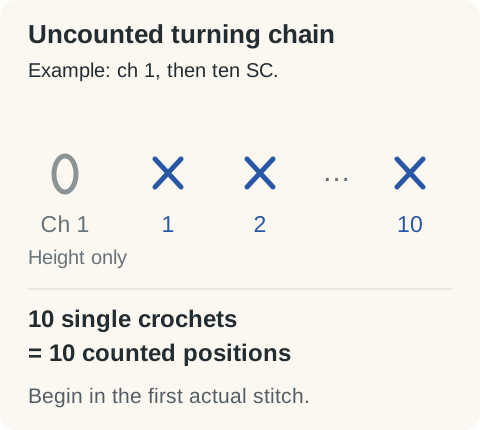
When the turning chain does not count
For an ordinary row without shaping, an uncounted turning chain adds height but contributes nothing to the stitch total. You make the full number of actual crochet stitches.
Imagine a sample with ten single crochet stitches. Its instructions say: “Ch 1, turn; sc in each st across. Turning chain does not count.”
You make the turning chain, then work into the first stitch and continue across all ten existing stitches. The completed row contains ten single crochets. Do not add the chain to make eleven.
Before moving on, identify the first and last stitch tops. Put a removable marker in each if they are hard to find. The single crochet lesson shows the basic stitch separately.
When the turning chain counts
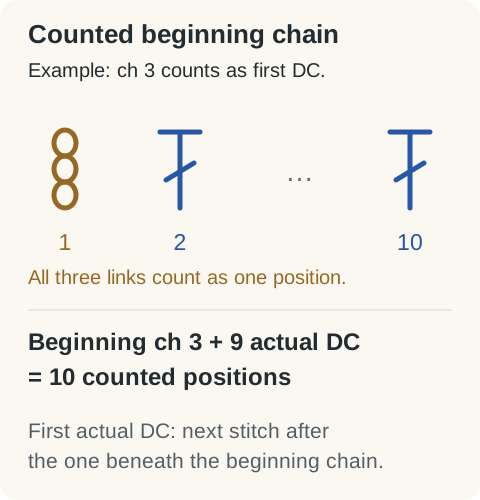
A counted turning chain takes the place of a stitch in the new row. In a plain row, you usually skip the stitch directly beneath it and work the next actual stitch into the following stitch. Follow any increase, corner or other special instruction instead when the pattern specifies one.
Consider a different sample with ten counted stitch positions. Its next row begins: “Ch 3, turn; beginning chain counts as first dc.”
For a plain ten-stitch row, that chain is the first counted position, and nine actual double crochet stitches complete the total. Making ten actual double crochets as well would give eleven counted positions.
On the following row, a counted chain at the far edge generally needs to be worked into. The pattern may specify which chain to use. Missing that position can remove a stitch even if the rest of the row looks tidy.
Our double crochet lesson teaches its own stated chain convention. Check it again when moving between lessons and other patterns.
Mark the position that really counts
If the beginning chain counts, place a marker in its top counted chain. If the chain does not count, mark the first actual stitch after making it. Move the markers as you work rather than leaving them several rows behind.
This gives you a visible answer to “Where does this row start?” At the far edge, the previous row's marker helps you recognise its last counted position.
Count the row before turning again. The stitch and row counter can hold a total, but you still need to recognise the correct insertion points. Recording ten does not prove that the ten stitches are in the right places.
Check an edge that keeps growing or shrinking
If a plain row gains one stitch, look for a counted turning chain followed by an extra stitch into the position underneath it. Also check whether an uncounted chain was accidentally treated as a stitch at the far end.
If the row loses one, check the first actual stitch after an uncounted chain and the top of a counted chain at the opposite edge. These are easy places to overlook while concentrating on the middle of the row.
Other causes are possible. Repeats, shaping and missed stitches elsewhere can change the total too. The crochet mistakes guide helps separate placement problems from changes in tension.
What if the pattern does not say?
Read the first few rows together. Does the pattern tell you to skip the first stitch? Does it ask you to work into the top of the previous beginning chain? Do the printed totals agree with a counted or uncounted start?
Those clues can help, but ask the designer if the convention remains unclear. Do not quietly switch rules halfway through a piece just to make one edge look straighter. The new rule can alter both the stitch count and the appearance of that edge.
For your own practice notes, record the chain number, whether it counts, the first insertion point and the ending point. Four short details can save a lot of unpicking later.
Once the rule is clear, the stitch-counting guide helps you check the completed row, repeat groups and rounds without counting a position twice.
Locking stitch markers
Openable markers help you find a stitch or the start of a round. A contrasting scrap of yarn works too.
Clover 3033 Quick Locking Stitch Marker SetView on AmazonYour next step
Keep making. Keep learning.
Follow the single-crochet lesson’s uncounted chain-one convention and identify its first and last actual stitches.
Practise a stated turning-chain rule