

How Much Yarn Do You Need for a Crochet Blanket?
The most useful starting point is the yarn used by a measured sample in the same stitch as your blanket. A blanket name such as throw or baby blanket does not tell you enough on its own.

The dimensions, stitch pattern, yarn and finishing all affect the amount. If you are following a complete pattern, begin with its yarn requirement for your chosen size. The calculation below helps you understand a simple rectangular project or assess a change. It does not replace the instructions for a shaped or pieced design.
Choose the finished dimensions
Write down the width and length you want in one unit, such as centimetres. Decide whether those dimensions include a border. A 120 cm by 90 cm centre panel needs more yarn if you later add a substantial border around it.
Use the dimensions after the intended finishing process. A sample that grows after washing should not be measured only straight from the hook if the blanket will also be washed.
For a fitted cover or a blanket intended to sit on particular furniture, measure that space rather than relying on a generic size label. Also consider how much overhang you want. Record that decision before making a very long foundation chain.
Make a representative sample
Use the yarn, hook and stitch pattern you plan to use for the blanket. Work enough fabric to measure it reliably without pulling it into shape.
Include a complete repeat where a stitch pattern has one. A little patch of plain stitches cannot tell you the consumption of a border full of shells or a centre filled with bobbles.
The gauge guide explains how to measure the fabric. For a first comparison, the single crochet lesson and moss stitch lesson give you different constructions to practise. Choose the one your project actually uses before measuring consumption.
Record the yarn used
You need the sample's finished dimensions and the length of yarn it contains. You can measure the used length directly, or estimate it from the sample's yarn mass and the labelled length per gram when that is appropriate for the yarn.
If weighing, use a scale precise enough for the sample and exclude markers, pins and other equipment. A very small mass measured on a coarse scale can produce a large error after multiplying it across an entire blanket.
Record whether your measurement includes tails, a foundation edge or test rows that are not part of the measured fabric. Apply the same convention when you estimate the project. A larger representative sample usually gives you more useful information than a few tiny stitches.
Scale the sample by area
For a plain rectangular panel in the same fabric:
Project area ÷ sample area × yarn used by sample = estimated panel yarn.
Here is a hypothetical example, not a measured blanket result:
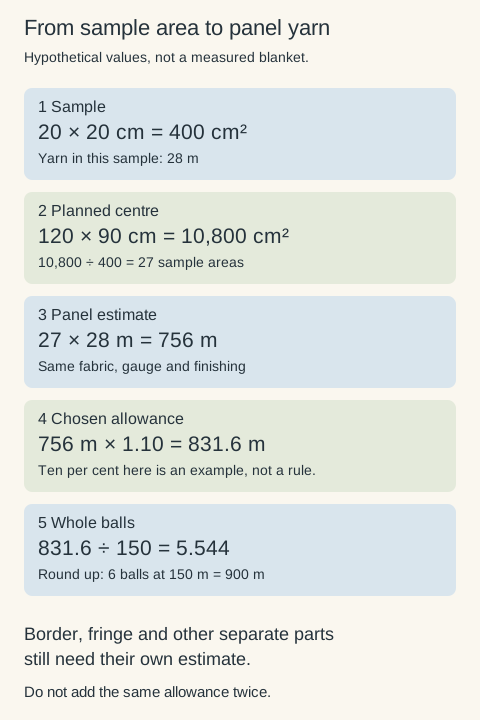
- The finished sample is 20 cm by 20 cm, so its area is 400 square centimetres.
- That sample uses 28 metres of yarn.
- The planned centre panel is 120 cm by 90 cm, so its area is 10,800 square centimetres.
- The panel contains the equivalent of 10,800 ÷ 400 = 27 sample areas.
- The estimate is 27 × 28 = 756 metres for the panel.
This assumes the same stitch pattern, yarn, hook, gauge and finishing. It does not include an unmeasured border, separate decorations or seams.
The yarn calculator follows this kind of measured-sample approach for rectangles. Read its allowance setting so that you do not accidentally add the same allowance twice.
Add the missing parts deliberately
Estimate a border separately if it uses a different stitch or substantial width. A narrow sample strip of that border, with its actual placement, is more useful than assuming it consumes yarn at the same rate as the centre panel.
Allow for additional test samples, fastening tails and any planned fringe. Decide on an uncertainty allowance appropriate to the project. Ten per cent is an example you might choose for a calculation, not a guarantee that it will cover every blanket.
If we add a chosen ten per cent allowance to the hypothetical 756-metre panel, the figure becomes 831.6 metres. The border is still separate; the allowance does not quietly turn an unmeasured border into a known quantity.
Convert metres into balls
Suppose the chosen yarn contains 150 metres per ball. For the 831.6-metre figure:
831.6 ÷ 150 = 5.544 balls, so round up to six whole balls. Those balls contain 900 metres in total according to their labels.
Keep enough precision until the final round-up. Do not round the length down first and then discover that the last ball leaves no room for variation. Compare metres with metres or yards with yards throughout.
If the blanket uses several colours, calculate each colour separately. The overall total does not tell you whether you have enough of the colour used for the final border.
Know when the rectangle estimate is not enough
A motif blanket has joining yarn and individual-square measurements to consider. The granny blanket planning guide separates those pieces from the rectangular area calculation. A large ripple or cable repeat may have edge effects that a tiny sample misses. A change of yarn can alter both consumption and fabric even within the same thickness category.
Keep your sample, measurements and working notes with the project. The beginner guide connects the foundation skills, while your chosen complete blanket pattern should supply the construction and repeat counts.
A tape measure and a clear ruler
Use a flexible tape for body measurements and a ruler or gauge tool to count stitches across a flat sample. Check centimetre and inch markings. Measure without stretching the fabric and follow the pattern’s gauge instructions.
Dritz 60-inch Tape Measure, Inches and CentimetresView on Amazon Westcott 10561 Clear Acrylic Ruler, 6 InchesView on AmazonYour next step
A little help as you make.
Use the finished dimensions and measured yarn consumption of your own representative sample.
Estimate a rectangular panel