


Two-Pass Crochet Colourwork: Track Loops, Spaces and Turns
By The Slow Stitch · Terminology: US Crochet Terms · Reading time: 8 min read · theslowstitch.com
Some textured colourwork uses two separate passes across the fabric before you turn it. One colour makes a framework, and the other works into its spaces. Both yarns remain attached, with one live loop safely parked while you work the other.
You will encounter this arrangement in Moroccan tile crochet, but patterns using that name can have different foundations, groups and edge treatments. This small V-stitch study shows one defined construction over five passes. Follow its counts as a unit rather than mixing them with a three-double-crochet block version.
The stitches use US terminology. Double crochet is UK treble. You need to recognise double-crochet tops, chain spaces and the difference between an edge stitch and a group. Reading the colour-grid guide first will help keep a fixed picture separate from the direction of working.
What You'll Learn
By the end of this tutorial you will be able to:
- Track five separate colour passes
- Secure each parked live loop
- Distinguish spaces inside and between V groups
- Turn only after the B passes
What You Need
Smooth yarn suited to the exercise; choose compatible contrasting colours where requested
A comfortable hook suited to your practice yarn
Locking markers or contrasting yarn scraps, Scissors, Blunt yarn needle
Use the materials above for practice, adjusting the hook if needed for comfortable stitches. For a finished project, follow its pattern’s yarn, gauge and care requirements.
Abbreviations
| Abbr | Full Term |
|---|---|
| ch | chain |
| sc | single crochet (US; UK double crochet) |
| dc | double crochet (US; UK treble) |
Set up two yarns and two loop markers
Choose two smooth, contrasting yarns of similar thickness: A for the framework and B for the nested groups. Use a comfortable hook, two locking markers or contrasting scraps, scissors and a blunt yarn needle. Keep the two balls separate so you can tell which strand feeds the current loop.
A V-stitch here means double crochet, chain one, double crochet in the same specified opening. It makes two double-crochet positions and one chain-one space. There is no additional chain between neighbouring V-stitches unless the instructions say so.
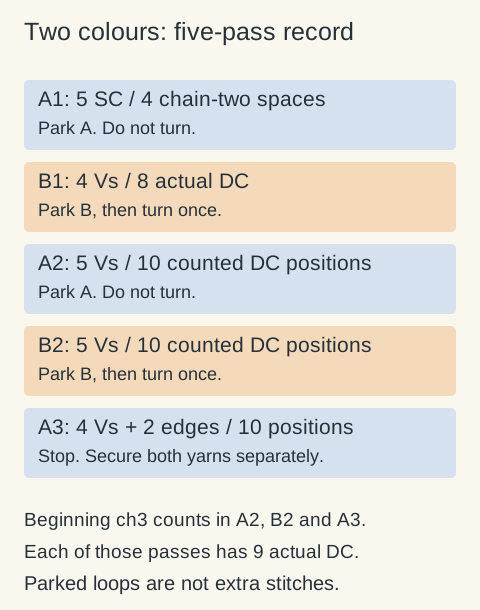
Label the passes A1, B1, A2, B2 and A3. A pass is one journey across with one colour; do not treat every colour pass as an instruction to turn. Keep a note with a tick beside each completed pass.
After A1 and A2, park A without turning. After B1 and B2, park B and turn once. This puts both parked loops at the starting edge for the next pair. Turning after A as well would move the work before B has filled the intended spaces.
Pass A1: make four chain spaces
With A, chain fourteen. Single crochet in the second chain from the hook. Then repeat chain two, skip two foundation chains and single crochet in the next chain four times.
You have five single crochets and four chain-two spaces. The worked foundation positions, counted from its beginning end rather than from the hook, are one, four, seven, ten and thirteen. The four spaces bridge the eight skipped foundation positions.
Do not turn or fasten off. Lengthen the live A loop just enough to remove the hook and put a locking marker through that loop. Close the marker so the loop cannot slip out. This parked loop is neither a completed stitch nor a chain space to work into.
Identify the first chain-two space at the opposite end, where this pass began. B1 will travel from there towards the parked A loop, in the same direction that A1 travelled.
Pass B1: fill the four spaces with V-stitches
With a separate B slip knot on the hook, make a standing double crochet in the first A1 chain-two space. Chain one and double crochet in that same space to complete the first V. Make one V-stitch in each of the remaining three chain-two spaces.
There are four B V-stitches: eight actual double crochets and four chain-one spaces. The standing stitch is the first actual double crochet, not a join followed by an extra stitch. Leave a finishing tail at its start.
Park the B live loop on its own marker. Both live loops are now at the finishing edge. Turn the work once. Keep A and B distinguishable, and check that neither marker has caught the ball-connected strand instead of the live loop.
You have completed two passes, not two independently turned rows. The first A framework and its nested B groups belong together. Do not work into B's top Vs simply because they are the most recent stitches.
Pass A2: return to the five older anchors
Put the hook back into the A live loop and remove its marker. Hold B1 behind the area you are working. Chain three, counting this as the first double-crochet position. Chain one, then double crochet in the first A1 single crochet at the current edge. The counted chain and this double crochet make the first V.
Work one V-stitch into each of the remaining four A1 single crochets. Reach down to those older stitch tops, keeping B1 behind so the new A stitches enclose that layer. Do not insert through the top loops of a B stitch or split its yarn.
There are five A V-stitches: ten counted double-crochet positions and five chain-one spaces. The beginning chain-three is included in the ten, leaving nine actual double crochets in this pass. The old five A1 single crochets each receive one V group.
Park A again without turning. Count five new chain-one spaces before picking up B. They are the next pass's targets, not the gaps between adjacent A groups.
Pass B2: resume the other live loop
- At A2's beginning edge, find its first chain-one space and the parked B loop behind it.
- With the empty hook, reach through that space from front to back. Catch the B live loop and bring it to the front.
- Remove B's marker only when the loop is safely on the hook. Keep A's separate parked loop secured.
This transfers an existing live loop; it does not make a new stitch. Chain three, counting it as the first double-crochet position, chain one and double crochet into the same A2 chain-one space. That makes the first B V group.
Make one V-stitch in each of the four remaining A2 chain-one spaces. B2 now has five Vs, ten counted double-crochet positions and five spaces. Its counted beginning chain-three replaces one actual double crochet; do not add a further double crochet beside it.
Park B and turn once. Both yarns are still attached. Check the side: a relaxed carried strand can reach its next working point, but a long loop hanging from an unmarked live stitch should be secured before you continue.
Pass A3: distinguish between groups from inside groups
Resume A and hold B2 behind the working area. Chain three for one counted edge double crochet. There are five A2 V groups, which create four gaps between neighbouring groups. These gaps are different from the five chain-one openings inside those Vs.
Make one V-stitch into each of the four between-group gaps of A2, reaching around the intervening B2 layer. Finish with one double crochet in A2's final edge double-crochet position. At that far edge, the counted chain-three from A2 is the position to locate.
This pass has one counted beginning edge, four Vs and one final edge: ten counted double-crochet positions and four chain-one spaces. Nine double crochets are actual stitches; the beginning chain supplies the tenth position. No extra chain is added between a V group and either edge.
Stop here. The study has shown an initial framework, nested colour groups, an older anchor row and two different kinds of space. Its five-pass record is not a blanket-size repeat or a prescription for a straight finishing border.
Read the count record before fastening off
A1 has five single crochets and four chain-two spaces. B1 has four Vs and eight actual double crochets. A2 has five Vs and ten counted double-crochet positions. B2 also has five Vs and ten counted positions. A3 has four Vs plus two edges, retaining ten counted positions.
The change from four spaces to five and back to four is part of this arrangement. It is not evidence that an extra group should be squeezed into the final edge. Check group spaces and counted stitch positions separately.
Fasten off A with a finishing tail. Secure B's parked live loop separately by cutting its yarn with a tail and drawing that end through the loop. Remove the marker only after the loop is secured. Finish both yarns on the back without gathering the edge.
If the layers separate into unrelated meshes, inspect which older anchors the A stitches actually entered and whether B was enclosed. If a side draws in, inspect the carried strand and beginning-chain height before changing the group counts. A border cannot correct a misplaced entire pass.
Keep the small study with its five-pass record. Before applying another tile pattern, identify its group definition, beginning-chain convention, attachment level and turning points afresh. The two-loop habit transfers between constructions; their numerical instructions do not automatically transfer with it.
 View diagram larger (opens in a new tab)
Ready for your next little make?
Keep learning with this free lesson, or explore complete crochet project PDFs in the shop, with materials, measurements, construction photos and finishing guidance.
What to Make Next
Three logical next steps to continue practicing:
Standing Single and Double Crochet: Start with New Yarn
Continue with the related stitch, chart or finishing method.
Double Crochet: Faster, Softer Fabric in US Terms
Continue with the related stitch, chart or finishing method.
How to Read a Crochet Chart: Visual Symbols Explained
Continue with the related stitch, chart or finishing method.