
Tapestry Crochet: Carry Two Colours Through a Small Sample
By The Slow Stitch · Terminology: US Crochet Terms · Reading time: 9 min read · theslowstitch.com
In this tapestry crochet sample, the yarn you are not using travels inside the stitches. It stays available for the next colour change instead of crossing the reverse as a long loose float. Managing that hidden strand is as important as placing the coloured stitches. The cover shows simple stripes; below, you will carry both colours along the same row.
You will make a fourteen-stitch, six-row exercise using US single crochet (UK double crochet). Two plain setup rows lead to four colourwork rows. The small block moves sideways once, so you can practise reading the row rather than changing colour from memory.
Start with the single-crochet lesson and identify the two loops of a completed top V. Use both top loops throughout this exercise. Back-loop-only, yarn-under and unturned-round versions are different constructions; do not add their movements halfway through this sample.
What You'll Learn
By the end of this tutorial you will be able to:
- Read fixed colour positions in both row directions
- Carry the unused yarn inside single crochet
- Change colour on the preceding stitch’s final pull-through
- Keep fourteen stitches while checking both fabric faces
What You Need
Two smooth, contrasting yarns of compatible thickness
A comfortable crochet hook suited to the chosen yarn
Removable markers or contrasting yarn scraps, Scissors, Blunt yarn needle
Use the materials above for practice, adjusting the hook if needed for comfortable stitches. For a finished project, follow its pattern’s yarn, gauge and care requirements.
Abbreviations
| Abbr | Full Term |
|---|---|
| sc | single crochet (US; UK double crochet) |
| ch | chain |
Prepare two yarns and a display-side marker
Choose smooth yarns A and B of similar thickness, a suitable hook, scissors, a blunt yarn needle and removable markers. Pick colours that are distinguishable in ordinary light. No particular fibre, hook size, finished measurement or yarn quantity is specified.
Use one supply of each colour. The same A strand serves both outer areas because it is carried through the middle B stitches. You do not need a third supply of A for the far side of the block.
The extra enclosed strand changes the fabric compared with plain single crochet. Assess its thickness and flexibility rather than expecting identical gauge. Avoid a very fuzzy yarn for this first exercise; it can hide whether the hook caught the carried strand by mistake.
Make two plain setup rows
With A, chain fifteen. Single crochet into the second chain from the hook and each remaining chain: fourteen single crochets in row one. Mark the face towards you as the display face.
For row two, chain one, turn once and single crochet under both top loops of each of the fourteen stitches. The chain does not count as a stitch. Keep the first and last actual tops marked.
The plain setup rows contain no carried B strand. Leave A attached for row three. Later, when comparing thickness, remember that the colourwork section encloses an additional yarn that the setup section does not.
Give the chart fixed column names
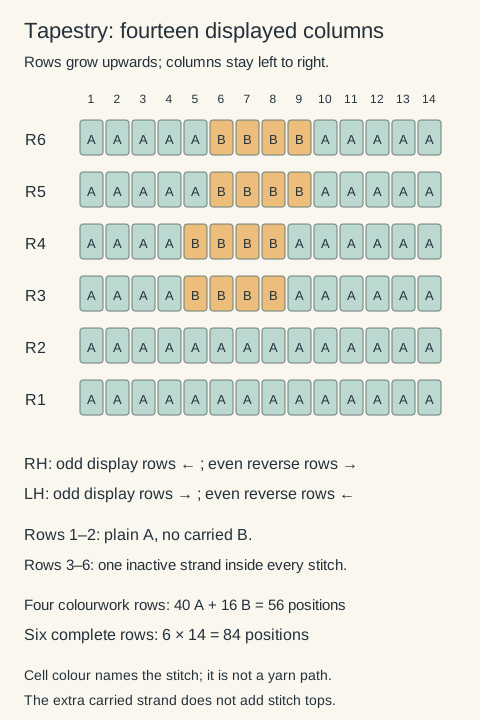
View the display face and number its columns one to fourteen from left to right. Those names stay fixed when you turn the piece. In the colourwork grid, one cell represents one single crochet, and the letter names the yarn used to begin that stitch.
The four colourwork rows are defined as follows:
- Rows three and four: A in columns one to four, B in columns five to eight, A in columns nine to fourteen.
- Rows five and six: A in columns one to five, B in columns six to nine, A in columns ten to fourteen.
Read a row in the direction you actually work it. For right-handed crochet, display-facing rows three and five run from column fourteen towards one; reverse-facing rows four and six run from one towards fourteen. For left-handed crochet, those directions reverse. Do not reverse just the colours while keeping the old row direction.
For right-handed work, row three is therefore six A, four B, four A; row four is four A, four B, six A. Left-handed work uses those two sequences in the opposite order. Rows five and six are five A, four B, five A in either direction.
Each colourwork row has ten A stitches and four B stitches. The sideways move changes their locations, not the total of fourteen.
 View diagram larger (opens in a new tab)
Enclose the inactive strand from the start of row three
Chain one and turn for row three. The display face is towards you. Lay B along the tops of the bases you are about to use, with a tail long enough to secure later. Keep the starting tail on the reverse; it is separate from the working B strand leading to its supply.
- Hold the inactive B strand along the top edge. Insert the hook beneath both top loops of the next base and beneath B.
- Yarn over with A and draw up a loop. B stays along the edge, beneath the hook.
- Yarn over with A and pull through both hook loops. The new single crochet encloses B without making a stitch from B itself.
Continue over B in every A stitch of the first run. Do not use B as an additional base, split it with the hook or draw it up as an extra working loop. There is still one new top for each base.
At the start of a display-facing row, arrange the inactive strand from the far, reverse side. At the start of a reverse-facing row, keep it on the near side towards you before laying it along the edge. These are ways of keeping the small edge connections on the chosen reverse, not different definitions of front and back top loops.
Change colour on the preceding stitch's final pull-through
- At the last A stitch before the B block, insert the hook and draw up a loop with A. Two A loops are on the hook.
- Lay A along the edge as the next carried strand. Catch working B and draw it through both hook loops.
- Begin the next stitch with the B loop now on the hook, enclosing A as you work.
That completed stitch still occupies the last A cell. The next base receives the first stitch begun with B. Do not move the colour change one whole stitch later because the final loop is already B.
Make four single crochets with B while enclosing A. On the fourth, draw up the loop with B, then use A for the final pull-through. Continue the final A run while enclosing B.
Each colourwork row has two handovers. Neither needs an extra chain, knot, skipped base or increase. Count the fourteen actual tops, excluding the active loop and uncounted turning chain.
The final pull-through can leave a contrasting strand at the boundary. A colour cell describes the stitch's assigned working yarn, not a guarantee that every visible strand of its top V will have the same colour. Check the stitch bodies and the written run lengths together.
Work the four colourwork rows
Finish row three using its stated run lengths. At the end, keep B available beside A and leave enough slack for the turn. Chain one with A, turn once and work row four in its reading direction, carrying B through the A sections and A through the B section.
Before row five, move the B block one column to the right on the fixed display-face grid. Both outer A runs now contain five stitches. Make row five, then turn and repeat the same displayed placements for row six.
Do not cut B between these rows. In this exercise it is enclosed across every colourwork stitch and travels to each new working edge. The two changes per row give eight handovers across rows three to six; they do not create eight pairs of cut ends.
Check fourteen tops at the end of each row. Moving the block changes the colour positions, not the width in stitches.
Control the carried length without gathering the fabric
Pause with the fabric relaxed after a short run. The enclosed strand should travel with the row rather than shorten it. Ease out excess slack before it is buried under many stitches, but do not pull so hard that the panel gathers.
If the inactive colour shows through, first check that it is actually enclosed in every stitch. Then compare the yarn thickness, contrast, hook and ordinary stitch tension. Forcing a very tight grip can make the work uncomfortable without concealing the strand consistently.
If a free strand crosses the reverse, find the stitches that failed to enclose it. A long float is not the carried construction specified here. Undo the affected section while its yarn path is visible.
The width troubleshooting guide separates changed counts from changed stitch size. A correct total can still produce a narrower panel if the carried yarn has been pulled short.
Check the block, both faces and the finish
Compare the completed fabric with the fixed column plan. Rows three and four place B at five to eight; rows five and six place B at six to nine. Ordinary single crochet has stitch lean and different front and reverse textures, so a grid of square cells does not promise perfectly square coloured pixels.
Use the counting guide to check structural tops separately from carried yarn and coloured boundary strands. Turn the piece over and inspect the edge connections and any missed enclosure.
After row six, fasten off A and cut B with enough length to secure both. Weave the starting and finishing tails using routes suited to the fabric, as in the finishing lesson. Follow the care instructions for both yarns.
With the two continuous supplies and no extra joins specified here, there are four tails to secure: the start and finish of A, and the start and finish of B. The eight colour handovers do not change that total.
This sample teaches a two-colour carry through turned rows. A project worked only from its display face may use a different reading direction and edge arrangement. A pattern that parks unused yarn locally instead of carrying it through an area needs separate instructions for how that supply becomes available again.
Ready for your next little make?
Keep learning with this free lesson, or explore complete crochet project PDFs in the shop, with materials, measurements, construction photos and finishing guidance.
What to Make Next
Three logical next steps to continue practicing:
Intarsia Crochet: Join Separate Colour Areas in Turned Rows
Compare separate supplies with carried yarn.
Single Crochet: The Foundation Stitch for Every Project
Review the stitch used throughout this exercise.
How to Join a New Ball of Yarn in Single Crochet
Practise the final pull-through with new yarn.