

Double Crochet Increases and Decreases: Dc2tog
By The Slow Stitch · Terminology: US Crochet Terms · Reading time: 5 min read · theslowstitch.com
An increase makes a double crochet row wider; a decrease makes it narrower. Practise each on a separate small swatch so you can see how the stitch count changes.
This lesson uses US double crochet, abbreviated dc. The equivalent UK stitch is treble crochet. The practice rows below use a beginning chain three that counts as the first double crochet.
For practice, gather smooth yarn, a suitable hook and a stitch marker or a short scrap of contrasting yarn. You should be comfortable with double crochet.
What You'll Learn
By the end of this tutorial you will be able to:
- Work two complete double crochets in one old base
- Leave the first partial double crochet unfinished for dc2tog
- Follow the three, two, four, three, one loop checkpoints
- Keep the counted beginning chain in twelve-position shaping exercises
What You Need
Smooth, light- or medium-coloured yarn for two separate practice rows or one base that can be reused
A crochet hook suited to the yarn, with room to see loops on the straight shaft
A removable marker or contrasting yarn scrap for the counted beginning chain, Scissors and a blunt yarn needle
Use the materials above for practice, adjusting the hook if needed for comfortable stitches. For a finished project, follow its pattern’s yarn, gauge and care requirements.
Abbreviations
| Abbr | Full Term |
|---|---|
| dc | double crochet (US; UK treble crochet) |
| ch | chain |
| st | stitch |
| dc2tog | double crochet two stitches together (US) |
Make a twelve-position base row
Chain fourteen. Work one double crochet into the fourth chain from the hook and each remaining chain. You have made eleven actual double crochets. The three skipped chains represent the first double crochet, giving twelve counted stitch positions.
Mark the top of that counted beginning chain. You will need to find it at the far end of the next row. If this foundation is unfamiliar, review double crochet before adding shaping.
Both exercises start with a row of twelve positions. Make two separate swatches with this starting row, or unravel the increase row before trying the decrease. The finished increase and decrease rows have different counts.
Work two double crochets into one base
Chain three and turn. This beginning chain counts as the first stitch, so leave the base position directly below it unworked. Make one double crochet in each of the next three stitches.
At the next base, make a complete double crochet. Then insert the hook into that same base and make a second complete double crochet there. Finish with one double crochet in each of the next seven positions, including the top of the old beginning chain at the far edge.
The instruction is:
Ch 3, turn; beginning ch counts as first dc. Dc in each of next 3 sts, 2 dc in next st, dc in each of next 7 sts. (13 dc)
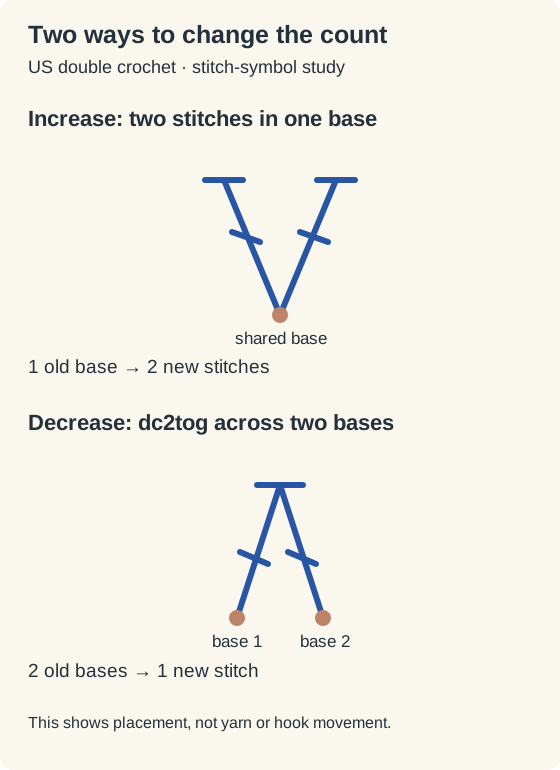
The increase uses one base position and produces two new stitches. Count thirteen stitches, including the beginning chain.
Each stitch in the increased pair has its own top V. If the next row is plain, those are normally two separate insertion points.
 View diagram larger (opens in a new tab)
Work a double crochet two together
Return to a twelve-position base. Chain three and turn, count that chain as the first double crochet, and leave the base position directly beneath it unworked. Make a double crochet in each of the next three stitches.
You will now work dc2tog across the next two bases:
- Yarn over, insert the hook into the first base, yarn over and draw up a loop. Three loops are on the hook.
- Yarn over and draw through two loops. Two loops remain. Leave the stitch unfinished.
- Yarn over, insert the hook into the next base, yarn over and draw up a loop. Four loops are on the hook.
- Yarn over and draw through two loops. Three loops remain.
- Yarn over and draw through all three loops. One active loop remains, and the decrease is complete.
Work one double crochet in each of the next six positions, including the top of the old beginning chain.
The instruction is:
Ch 3, turn; beginning ch counts as first dc. Dc in each of next 3 sts, dc2tog over next 2 sts, dc in each of next 6 sts. (11 dc)
The decrease uses two bases but produces one top. You should have eleven stitches, including the beginning chain.
Check the middle and the edges
If an increase row has the wrong total, confirm that the two new stitches share one base. Two double crochets in two separate bases do not increase anything.
If a decrease row has the wrong total, check that you left the first stitch unfinished and gathered the next base before the final pull-through. Completing both separately leaves the original total unchanged.
Then check the marked beginning-chain position. Missing that last position leaves you one stitch short. Working into the position beneath the new counted starting chain can add an extra stitch.
Follow the exact shaping method
A group of unfinished stitches closed together in one base can make a cluster rather than a decrease across separate bases. Read both the closure and insertion instructions.
Taller stitches use more yarn overs and more staged pull-throughs. Do not convert their decreases by changing only the stitch name; check how many loops remain before gathering the next base.
Use the glossary to check abbreviations. Count the stitches in your finished row, then check both edges for any missed or extra stitches. You can use the stitch counter to keep track.
Ready for your next little make?
Keep learning with this free lesson, or explore complete crochet project PDFs in the shop, with materials, measurements, construction photos and finishing guidance.
What to Make Next
Three logical next steps to continue practicing:
Double Crochet: Faster, Softer Fabric in US Terms
Check the ordinary yarn-over and pull-through sequence.
How to Increase in Single Crochet
Compare two complete stitches sharing one base.
Single Crochet Decrease: How to Work Sc2tog
Compare a different stitch’s unfinished loop sequence.