

Single Crochet Decrease: How to Work Sc2tog
By The Slow Stitch · Terminology: US Crochet Terms · Reading time: 4 min read · theslowstitch.com
Single crochet two together, abbreviated sc2tog, turns two neighbouring stitches into one new stitch. It reduces the total by one while joining those two bases beneath a shared top.
This guide uses US terminology. US single crochet is UK double crochet, so the comparable UK abbreviation is dc2tog. Check your pattern's terminology and special-stitch notes before using the method.
What You'll Learn
By the end of this tutorial you will be able to:
- Draw up one loop from each of two neighbouring bases
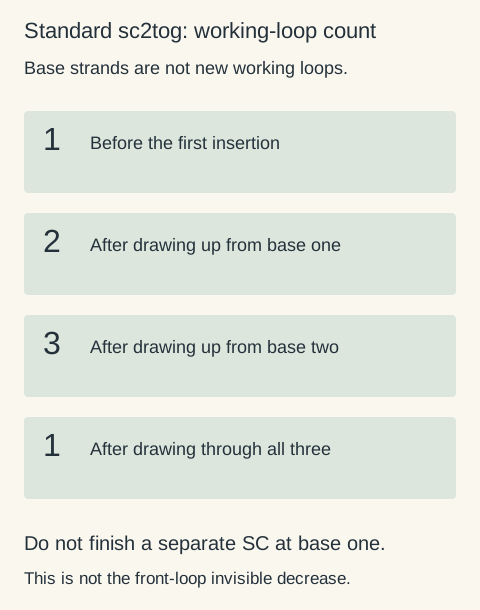
- Keep three working loops before closing the decrease
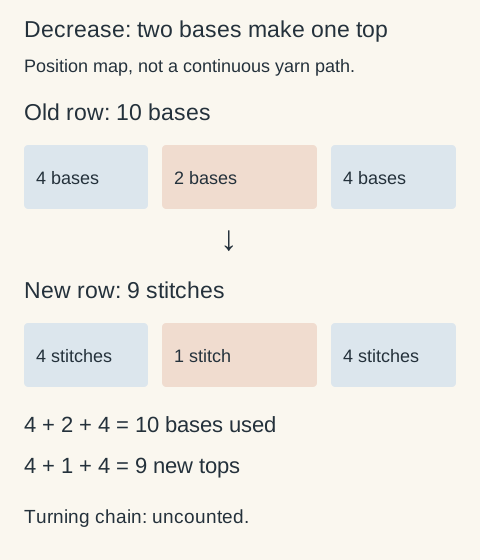
- Count one new top above two used base stitches
- Turn ten base positions into nine new stitches
What You Need
Smooth, visible yarn for a small two-row practice piece; teaching close-ups use separate demonstration fabric
A hook suited to the yarn with comfortable space on its shaft
A removable marker or contrasting yarn scrap for each edge, Scissors and a blunt yarn needle
Use the materials above for practice, adjusting the hook if needed for comfortable stitches. For a finished project, follow its pattern’s yarn, gauge and care requirements.
Abbreviations
| Abbr | Full Term |
|---|---|
| sc | single crochet (US) |
| ch | chain |
| st | stitch |
| sc2tog | single crochet two stitches together (US) |
Prepare a small practice row
The close-up isolates the three-working-loop checkpoint on separate demonstration fabric. Follow the written base selection and count key for the complete ten-to-nine-stitch exercise rather than counting every visible stitch in the cropped image.
Chain eleven. Work a single crochet into the second chain from the hook and each remaining chain. Count ten single crochet stitches.
For the next row, chain one and turn. That turning chain does not count as a stitch in this exercise. Mark the first and last stitch tops if they are hard to recognise.
Work a single crochet into each of the first four stitches. You will decrease across the fifth and sixth stitches, then finish with one single crochet in each of the remaining four stitches.
Make the standard sc2tog
- Insert the hook under both top loops of the fifth stitch.
- Yarn over and draw a loop through that stitch. You have two loops on the hook. Leave them there.
- Insert the hook under both top loops of the sixth stitch.
- Yarn over and draw up another loop. You now have three loops on the hook.
- Yarn over once more and draw through all three loops.
One active loop remains. The decrease is complete, and the two base stitches now have one shared new top. Continue in the next unused stitch, the seventh stitch of the old row.
The practice row is:
Ch 1, turn. Sc in each of the next 4 sts, sc2tog over the next 2 sts, sc in each of the next 4 sts. (9 sc)

Check the count before continuing
The instruction consumes 4 + 2 + 4 = 10 base stitches. It produces 4 + 1 + 4 = 9 new stitches.
Do not count the two gathered bases as two stitches in the new row. Find the single V at the top of the decrease. On the next plain row, that V normally receives one stitch unless the pattern tells you otherwise.
If your count is still ten, check whether you finished the first single crochet before moving to the second base. That would make two separate stitches rather than one decrease.
If the count dropped to eight, you may have skipped a base as well as working the decrease. Trace the two gathered bases, then find the next unused stitch before going on.
 View diagram larger (opens in a new tab)
Standard and invisible decreases are different
The method above uses both top loops of each base. A common amigurumi invisible decrease instead gathers selected front loops before finishing the stitch. The movements and appearance differ.
Use the decrease your pattern specifies. A designer may choose a particular method for the face of the fabric, shaping or texture. Do not silently substitute one because its name sounds neater.
Skipping a stitch is another way to reduce the count, but it can leave a more visible opening. It does not reproduce this sc2tog structure.
 View diagram larger (opens in a new tab)
Keep the two bases close without forcing the hook
Draw the gathered loops to a workable height on the shaft. If they are very tight, pause and ease them before pulling through all three. Pulling harder can split the yarn or hide the two bases you need to inspect.
This is a practice row, so stop and remake the decrease if the insertion is unclear. A quick check is more useful than carrying an uncertain count into the next row.
Review single crochet if the basic movement is new. The amigurumi lesson shows how increases and decreases contribute to a shaped piece, while the glossary helps you interpret the abbreviations in your own pattern.
Ready for your next little make?
Keep learning with this free lesson, or explore complete crochet project PDFs in the shop, with materials, measurements, construction photos and finishing guidance.
What to Make Next
Three logical next steps to continue practicing:
How to Increase in Single Crochet
Compare the inverse change in stitch count.
Single Crochet: The Foundation Stitch for Every Project
Check the ordinary one-base movement.
Amigurumi Basics: Spirals, Shaping and a Practice Piece
Follow the method actually specified for the complete shape.