Front Post and Back Post Double Crochet
By The Slow Stitch · Terminology: US Crochet Terms · Reading time: 5 min read · theslowstitch.com
Post stitches change the route your hook takes around a stitch. Instead of inserting beneath its top loops, you pass around the body below them. This can move the texture towards or away from the face you are looking at.
This guide uses US front post double crochet (FPdc) and back post double crochet (BPdc). In UK terminology, these are front post and back post trebles. You should be comfortable making ordinary double crochet before trying them.
What You'll Learn
By the end of this tutorial you will be able to:
- Identify a stitch post separately from its top loops
- Follow front-post and back-post hook routes from one working face
- Complete the double-crochet pull-throughs after drawing up a loop
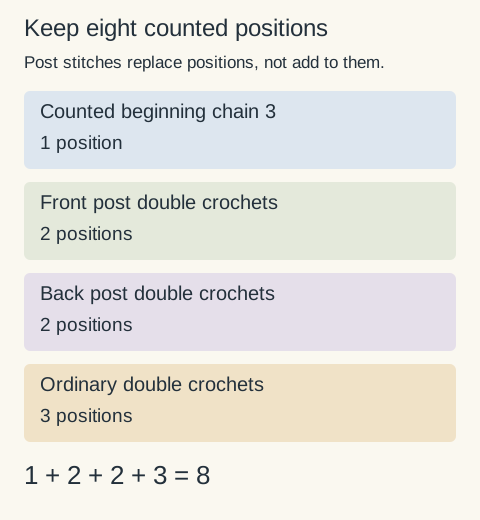
- Keep eight counted positions without working twice into one base
- Avoid adding a second stitch into the top V above a used post
What You Need
Smooth light-coloured yarn for a small two-row practice piece
A hook suited to the yarn, with enough space to pass around one post comfortably
A removable marker or yarn scrap for the counted chain, Scissors and a blunt yarn needle
Use the materials above for practice, adjusting the hook if needed for comfortable stitches. For a finished project, follow its pattern’s yarn, gauge and care requirements.
Abbreviations
| Abbr | Full Term |
|---|---|
| dc | double crochet (US) |
| ch | chain |
| FPdc | front post double crochet (US) |
| BPdc | back post double crochet (US) |
Begin with posts you can identify
Revisit ordinary double crochet if you need to check its yarn overs and pull-throughs. The placement close-up deliberately uses an unthreaded hook to make the post route visible. It is a separate rehearsal, not a photograph of the yarn-over stage or the complete counted sample.
Make a short row of ordinary double crochet. For an eight-position practice base, chain ten, work a double crochet in the fourth chain from the hook and each remaining chain, and count the three skipped chains as the first stitch. You have seven actual double crochets plus the counted chain, making eight positions.
You cannot work an ordinary post stitch around a bare foundation chain: there is no completed stitch body there yet. Look below the top Vs of your base row and identify the longer bodies of the actual double crochets.
Mark the top of the counted starting chain. For this exercise, the next row begins with chain three, which counts as its first double crochet.
Work a front post double crochet
Chain three and turn. Leave the position beneath that counted chain unworked. Locate the next actual double crochet post.
- Begin with one active working loop and yarn over once. Two working loops are held before insertion.
- Bring the hook from the front face through the gap on the approaching side of the designated post.
- Pass behind that post and bring the tip out through the gap on its other side, back to the front. The post lies across the front of the hook.
- Yarn over and draw a loop back around the post. Three loops are now on the hook.
- Yarn over and draw through two loops, then yarn over and draw through the remaining two.
You have made one FPdc. The path is front, behind the post, front again. It is a route around the post, not through the fibres of the stitch body.
Make another FPdc around the next post. Leave the top V of each of those two bases unworked; the post stitches already represent those positions in the new row.

Work a back post double crochet
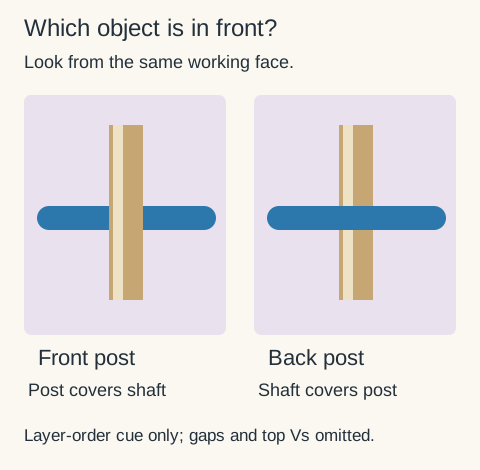
At the next post, keep the same face towards you. You do not turn the whole sample over to perform the back-post movement.
- Begin with one active working loop and yarn over once. Two working loops are held before insertion.
- Bring the hook from behind the fabric through the gap on the approaching side of the designated post.
- Pass in front of that post and take the hook through the other gap to the back again. The post lies behind the hook.
- Yarn over and draw a loop around the post. Three loops are on the hook.
- Complete the double crochet with two yarn-over-and-pull-through-two movements.
The path is back, in front of the post, back again. Repeat around the next post to make a second BPdc.
These relative front-and-back paths apply to either handedness. The side from which your hook approaches is mirrored for a left-handed working direction; do not copy an unlabelled left/right arrow without checking its context.
 View diagram larger (opens in a new tab)
Finish and count the exercise
Work ordinary double crochet into the next three remaining positions: two actual double crochets, then the top of the old counted beginning chain.
You should have eight counted positions: one beginning chain, two FPdc, two BPdc and three ordinary double crochets.
The new stitches used the same eight base positions once each. If you also work under the top V above a post you have already used, you add an unintended stitch.
 View diagram larger (opens in a new tab)
Keep texture and fabric face separate
Front post means towards the face currently facing you. After a turned row, that is the other face of the sample. A pattern that keeps a raised column on one particular face may alternate front and back post instructions as the work turns.
In unturned rounds, the same face generally stays towards you, so the instruction can behave differently. Follow the pattern's construction and count rather than swapping front and back post stitches by appearance alone.
If a post stitch pulls the row down, check its reach and loop height before tightening it further. A taller post stitch may be specified in a cable or overlay pattern, but changing stitch height on your own can alter the fabric.
Keep the glossary nearby for the exact post-stitch abbreviations. After checking the eight positions, record the row in the counter and compare both faces of the sample before trying a longer rib or cable section.
Ready for your next little make?
Keep learning with this free lesson, or explore complete crochet project PDFs in the shop, with materials, measurements, construction photos and finishing guidance.
What to Make Next
Three logical next steps to continue practicing:
Crochet Ribbing: Back-Loop and Post-Stitch Practice
Keep alternating columns aligned after turning.
Front Loop Only and Back Loop Only Crochet
Compare placement beneath one top strand with placement around a post.
Double Crochet: Faster, Softer Fabric in US Terms
Review the ordinary yarn overs and pull-throughs.