Tunisian Crochet vs Regular Crochet: What Changes?
Tunisian crochet uses a hook while retaining loops across a forward pass, then working them off during a return pass. That row structure is the main practical change to understand before choosing a hook or beginning a large project. You do not need to abandon ordinary crochet skills.

Recognising a chain, controlling yarn and identifying stitch placement still help. You do need to learn which retained loops and edge positions belong to a Tunisian row.
Compare the row structure
In an ordinary row of single crochet, you complete each stitch before moving to the next. Several loops can be on the hook during the stitch, but you normally return to one active loop before beginning the next stitch.
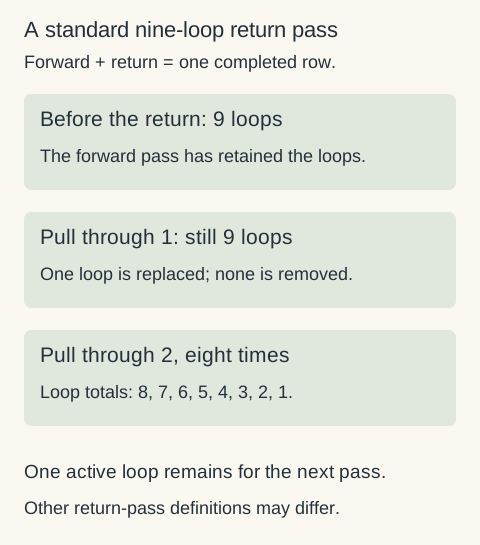
In a basic Tunisian forward pass, new loops remain on the hook. A standard return pass works them off without turning the fabric. The forward and return passes together form one completed row.
For a small nine-loop example, the standard return begins by drawing yarn through one loop. Nine loops are still held. Eight successive pull-through-two movements then leave one loop. That is count arithmetic, not nine completed rows or nine separate ordinary single crochets.
The single crochet lesson helps distinguish the ordinary stitch sequence. The word Tunisian does not mean that every specialist Tunisian method uses this same return or working-face arrangement.
Check the hook's usable length
A wider forward pass needs room for more retained loops. A Tunisian hook may have a long straight shaft or a cable. A suitable ordinary hook can hold a small sample, but a bulky handle or grip can stop loops sliding where they need to go.
Hook diameter remains a separate choice from length. Having enough space for the loops does not establish the right gauge. Start with the pattern's guidance and compare the resulting fabric before buying equipment for a large piece.
Use the hook converter to interpret common size labels, then check the actual millimetre marking and manufacturer information. A comfortable handle and sufficient working length both matter.
Learn the edges alongside the interior stitch
The retained loop at the beginning of a basic forward pass already represents its first edge position. Picking up an extra loop there can increase the width. Missing the far edge can reduce it.
For a nine-position sample using one retained starting edge and one separately worked final edge, there are seven interior positions. One plus seven plus one equals nine. A count of nine does not prove the insertion points were correct, so inspect the bars as well.
Simple, knit and purl stitches differ in interior insertion or yarn position. Their names do not make them ordinary knitted stitches, and they should not be substituted for each other merely to reach the same loop count.
Expect a new fabric comparison
Some Tunisian fabrics curl even when their counts are correct. Stitch choice, yarn, hook and construction all affect the result. A border or finishing treatment may be part of a design, but neither is a universal repair for an excessively tight or incorrectly worked sample.
Compare width, height, drape and both faces after the appropriate care treatment. A knitted-looking V does not establish knitted gauge or stretch. The gauge guide helps keep the comparison measurable.
Do not assume a Tunisian version of an ordinary crochet project will need the same yarn quantity. Measure consumption in the actual stitch pattern and construction.
Plan the finishing edge
After the final return pass, the top may need a specified bind-off rather than an abrupt fastening off. A slip-stitch-style bind-off can finish positions without collecting a whole new forward pass, but its insertion points and count must be defined.
Keep that finish relaxed enough for the intended edge. A tightly drawn bind-off can gather a sample whose previous rows had the correct width. The finishing lesson explains related loop handling; it is not a substitute for the chosen Tunisian bind-off directions.
Begin with a small, clearly labelled sample. Learn the setup, both edges, one interior stitch, the return and the finish as one connected sequence before adding shaping, colourwork or entrelac joins.
Your next step
A little help as you make.
Hook diameter and usable loop-holding length are separate choices.
Check the hook’s actual size marking