
Puff, Bobble and Popcorn Stitches: Understand the Closures
Puffs, bobbles and popcorns can all make raised texture, but they build and close that texture differently. The useful first question is not which looks roundest in a photograph.

It is which loops or completed stitches the instruction gathers. This guide uses US terms and compares common definitions. Special-stitch names and abbreviations vary, so the definition in the actual pattern takes priority.
A puff gathers drawn-up loops
In a common puff, you repeat yarn-over and drawn-up-loop movements in the specified base before closing the accumulated loops. You do not finish a separate ordinary double crochet after every pickup.
For one explicitly defined counting example, start with one active loop and repeat “yarn over, insert, yarn over, draw up a loop” three times in the same base. Each repeat adds two retained loops, giving seven before the closing movement.
A pattern may use more pickups or close the puff in stages. Check its final pull-through and any securing chain. The example explains loop accumulation; it does not supply a complete puff-stitch row or its counting convention.
A bobble gathers unfinished stitches
A common double-crochet bobble leaves several double crochets unfinished in one base, then closes their remaining loops together. Each partial stitch has already worked through part of the double-crochet sequence.
For a five-part version that leaves one additional loop after each unfinished double crochet, the hook holds the original active loop plus five retained loops: six before the shared closure. That differs from the seven-loop puff example because the intermediate pull-throughs differ.
Work all the partial stitches in the specified base for that bobble. Gathering unfinished stitches across separate bases instead can make a decrease. The double crochet lesson explains the ordinary stitch's staged pull-throughs.
Do not assume every stitch called a bobble uses five partial double crochets. Taller stitches, different group sizes and different closures need their own definitions.
A popcorn gathers completed stitches
In a common popcorn, a group of ordinary stitches is completed in one base first. The active loop is then temporarily released while the hook enters a designated earlier stitch in the group and draws the released loop through to gather the group.
That is different from retaining all the unfinished stitch loops on the hook. In a five-double-crochet version, you complete five double crochets before performing the gathering join.
The direction of that gathering insertion affects which face the texture appears on. Follow the stated front/back instruction, especially on turned rows. Any closing chain also needs a defined counting treatment.
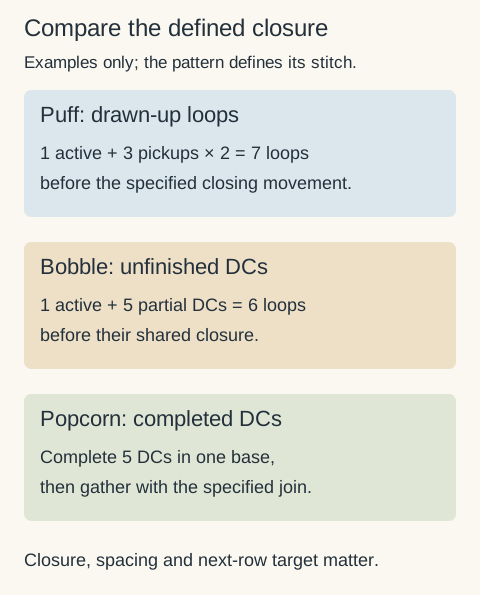
Compare the base and the top count separately
All three examples can use one base position, yet contain several internal movements. A pattern may treat the finished texture as one counted unit, with separate spacing stitches around it. Read what happens to a securing chain and where the next row enters.
Five internal double crochets do not automatically mean five independent bases on the following row after they have been gathered as a popcorn. Equally, do not ignore a spacing chain that the pattern counts as its own position.
Keep the chart-reading lesson beside the written special-stitch definition. A decorative symbol's name alone does not give the number of pickups, closure or next-row target.
Choose from a made comparison
Use the same yarn and hook to compare explicitly labelled versions. Inspect both faces, the space around each group and the way the next row sits above it. Count the row using the chosen definition before assessing its appearance.
Yarn consumption and gauge can differ from plain stitches and between texture versions. Measure the actual repeat before estimating a project; the gauge guide helps with that record.
A clear sample label should name the version, base placement, number of partial or completed stitches, closure, securing chain and counted output. Those details make a repeat reproducible. A photograph labelled only “bobble” leaves too much to guess.
Your next step
Keep making. Keep learning.
Distinguish a partial double crochet from a completed stitch before reading a texture definition.
Follow the ordinary double-crochet stages