How to Substitute Yarn for a Crochet Pattern
The yarn in the pattern is unavailable, or you would rather use something already in your basket. Before choosing a replacement, find out what the original yarn is doing for the project.

Thickness matters, but so do the finished fabric, usable length and care instructions. A good candidate is a starting point for a swatch. It is not a promise that the finished item will match the photograph or measurements.
Collect the original yarn details
Read the pattern's materials, gauge and finishing notes together. Use the yarn-label guide to separate thickness, ball mass and usable length. Record the yarn name, thickness category, fibre content, length per ball, amount required for your size and the stitch pattern used for the gauge sample.
Also note the intended fabric. A firm bag panel and a softly draping scarf can call for different results even when the yarn labels share a category number. The pattern's suggested hook is useful context, but your own sample determines whether you can achieve its gauge.
If the original yarn has been discontinued, look for its maker's archived information or ask the designer. Do not substitute a guessed thickness for a missing specification.
Compare more than the weight name
Yarn weight describes thickness; a ball's grams describe mass. Neither a matching ball mass nor a word such as DK guarantees a matching fabric.
Start with a similar thickness category, then compare fibre and construction. Look at whether the yarn is smooth, loosely spun, firmly twisted, fuzzy, a chain-like construction or a filled tube. Those differences can affect how visible the stitches are and how the fabric behaves.
For a first substitution, changing fewer features makes the comparison easier. Replacing a smooth yarn with another smooth yarn is a smaller experiment than changing thickness, texture and fibre at the same time.
Avoid using a fibre name as a guarantee of stretch, warmth, washability or suitability for a child. Check the actual product information and the needs of the finished item. The beginner learning guide helps you place these decisions alongside the basic skills.
Make the swatch the pattern asks for
Use the specified stitch pattern and construction. A single crochet label gauge does not replace a pattern gauge measured over textured stitches or colourwork. If the project is worked in rounds, follow any instruction to swatch in rounds too.
Make enough fabric to measure an interior section without counting a distorted edge. Follow the pattern's washing or blocking directions only where they are compatible with the replacement yarn's care requirements. Let the sample settle and dry before taking the required finished measurement.
Our gauge guide explains the measurement process. Keep the sample and a note of the yarn, hook and finishing method together. Otherwise, two promising swatches can become surprisingly hard to identify later.
Judge the fabric as well as the numbers
If you have too many stitches in the specified width, your stitches are smaller than the target; a larger hook is a common next experiment. Too few means the stitches are larger, so try a smaller hook. Make another sample rather than assuming one adjustment will solve it.
Then handle the result. Does it fold, hold its shape or show gaps in the way the project requires? Matching the stitch count with a very loose or stiff fabric may tell you the yarn is a poor replacement for that design.
Check row gauge separately. A matching width does not guarantee the correct height. Do not rewrite shaping rows from a simple ratio without checking how the construction works. Ask the designer if the pattern gives no suitable adjustment.
Calculate length before buying balls
Compare metres with metres, or yards with yards. Do not compare the original ball count directly with the replacement ball count unless their usable lengths match.
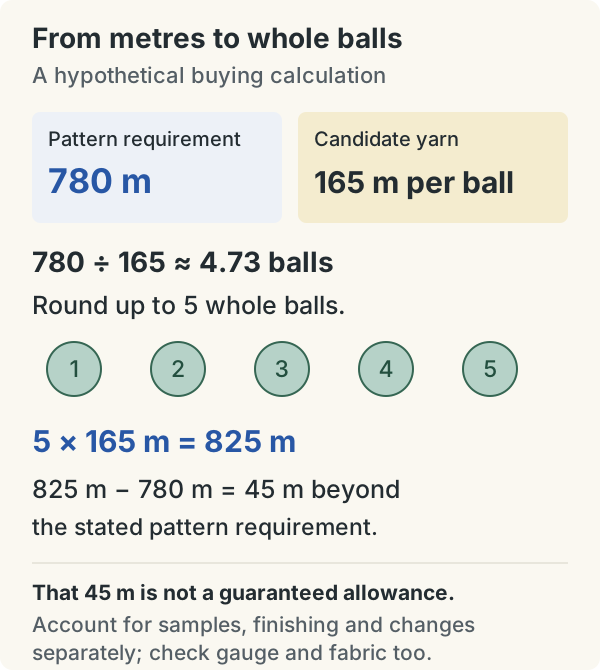
For a hypothetical example, suppose a pattern requires 780 metres, and your candidate yarn contains 165 metres per ball:
780 ÷ 165 = about 4.73 balls.
Rounding up gives five balls, containing 825 metres in total. That leaves 45 metres beyond the stated requirement. This arithmetic does not prove that 45 metres covers your swatches, longer finishing tails, a changed size or different yarn consumption. Account for those separately, and check whether the pattern's requirement already includes an allowance.
If the pattern only lists three balls of its original yarn, find the length of each original ball first. If it lists actual yarn used, keep that separate from the quantity recommended for purchase.
For colourwork, calculate each colour individually. Spare main-colour yarn does not make up for a shortage in a border colour.
Use a manageable practice comparison
If you are learning how different yarns behave, compare a small sample from the single crochet lesson with one using the movements in double crochet. Label each sample. Treat that as learning about the fabric, then make the actual project-gauge sample before committing to a fitted design.
For a simple rectangle, the yarn calculator can estimate from your measured sample and yarn use. It does not predict a shaped garment or turn a mismatched gauge into a compatible substitution.
The useful question is not just “Can I use this yarn?” It is “Can this yarn produce the fabric, measurements and care requirements this particular pattern needs?” A labelled swatch gives you a much better answer than the category name alone.
A tape measure and a clear ruler
Use a flexible tape for body measurements and a ruler or gauge tool to count stitches across a flat sample. Check centimetre and inch markings. Measure without stretching the fabric and follow the pattern’s gauge instructions.
Dritz 60-inch Tape Measure, Inches and CentimetresView on Amazon Westcott 10561 Clear Acrylic Ruler, 6 InchesView on AmazonYour next step
Keep making. Keep learning.
Measure the actual project-stitch sample and assess the fabric before committing to the full quantity.
Check your candidate yarn’s gauge